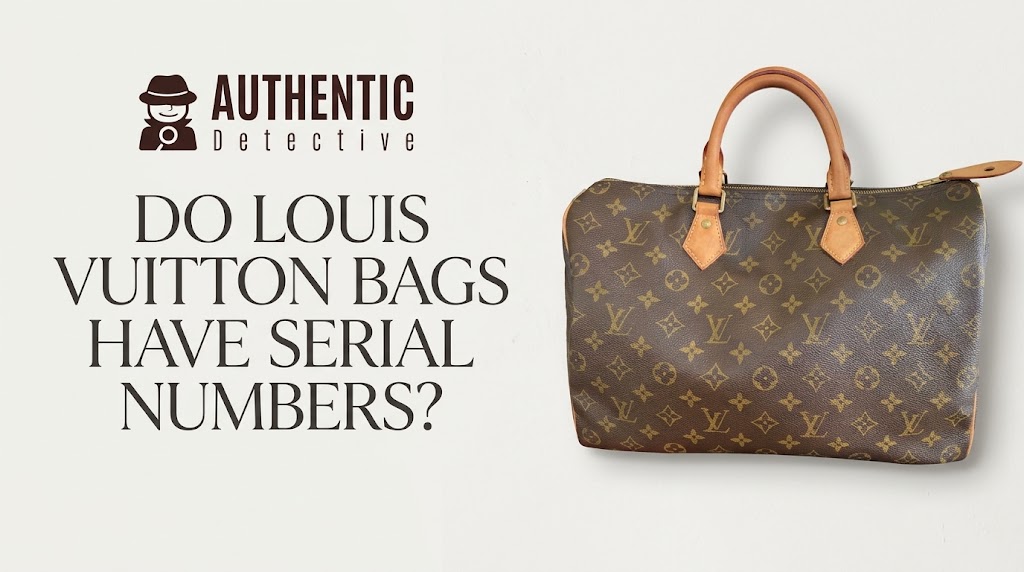
Louis Vuitton bags don’t have serial numbers. They use a date code instead: a stamp of 2 letters and 4 digits (like VI1004) that shows the factory and production date, not a unique ID. A correctly formatted date code alone doesn’t prove your bag is real; counterfeiters copy the format too. Below is where to find it, how to read it by era, and what else genuine LV bags always get right.
Louis Vuitton Doesn’t Use Serial Numbers: Here’s What It Actually Uses
If you’ve searched “Louis Vuitton serial number,” here’s the short answer: Louis Vuitton has never used unique serial numbers the way brands like Chanel or Gucci do. Instead, since the early 1980s, LV has stamped its bags with a date code, an internal production code that tells you the factory location and approximate manufacturing date, not a one-of-a-kind identifier tied to your specific bag.
This distinction matters because a date code is a production detail, not proof of ownership or authenticity on its own. Two different bags, one real and one fake, can carry the exact same date code if a counterfeiter copies a known authentic format.
If you’re weighing a secondhand Louis Vuitton purchase and want the fuller picture beyond just the date code, our Louis Vuitton authentication guide covers the common counterfeit red flags we see across every LV style, along with what our certificate actually verifies.
Where to Find the Date Code
Date code placement varies by bag style and era, but it’s most commonly found:
- On a small leather tab sewn into an interior seam or pocket
- Stamped directly into the lining (common on Alcantara or microfiber interiors)
- On a riveted leather tab underneath a suspended pocket
- Near the D-ring attachment on some styles
On the popular Neverfull, for example, it’s typically found on the leather tab under the right-hand side of the interior flap. If you’re struggling to find one and your bag looks vintage, don’t panic. Pieces made before the early 1980s never had date codes to begin with.
How to Read the Date Code by Era
The format has changed several times since Louis Vuitton introduced it. Match your code to the right period below:
| Era | Format | How to read it |
|---|---|---|
| Before 1980 | No code | Authentication relies fully on materials, stitching, and construction |
| 1980s | 3–4 digits only | First digits = year, remaining = month |
| 1990–2006 | 2 letters + 4 digits | Letters = country of manufacture; 1st & 3rd digits = month, 2nd & 4th = year |
| 2007–March 2021 | 2 letters + 4 digits | Letters = factory location; 1st & 3rd digits = week of year, 2nd & 4th = year |
| March 2021–present | No external code | Replaced by an embedded RFID microchip, scanned in-store by LV staff |
Example: A date code of VI1004 breaks down as VI (a factory in France) + 10 (October) + 04 (2004), so this bag was made in France in October 2004.
The Factory Letters Only Prove Something When They Match Your “Made In” Stamp
This is the single most useful cross-check you can do yourself, and it’s one counterfeiters frequently get wrong. Every Louis Vuitton bag also has a “Made in [Country]” stamp on its main leather tag. The letters in your date code should correspond to that same country.
A few consistently documented examples:
- VI, SD, FL: associated with factories in France (note: SD and FL have also been used for U.S.-made pieces in some periods, so always cross-check against the “Made in” stamp rather than the letters alone)
- CA: associated with Spain
- FA: associated with Switzerland
If your date code letters point to one country but the “Made in” stamp says another, that mismatch is a clear red flag. Because the full factory-code list has changed and expanded over decades, and several letters have been reused across different countries at different times. Treat any single-letter lookup as a starting point, not a final verdict. This is exactly the kind of detail our authenticators cross-reference against Louis Vuitton’s actual production records rather than a static public list.
Why a Valid Date Code Doesn’t Guarantee Authenticity
A properly formatted date code only tells you it’s consistent with a real one, not that the bag itself is genuine. Professional authenticators flag a bag as suspicious when they see:
- A date code format that doesn’t match the era the bag’s style was actually produced in (e.g., a “week” format code on a bag style that predates 2007)
- Factory letters that don’t match the “Made in” stamp
- A code stamped in a font, spacing, or tab material inconsistent with genuine examples from that period
Because counterfeiters can and do copy known-correct codes, the date code should always be treated as one signal among several, not the final word.
Other Things to Check Alongside the Date Code
A genuine Louis Vuitton bag should also hold up on these details:
- Monogram alignment: the canvas pattern is never randomly placed; on most styles it follows a consistent, deliberate layout, and pattern pieces are matched at the seams
- Stitching: even stitch count, consistent tension, and thread color that matches the leather trim (uneven or yellow-tinted stitching is a common fake tell)
- Hardware: should feel weighty, be finished in solid brass (plated), and show engravings that are crisp, not shallow or blurry
- Leather (Vachetta): untreated vachetta leather trim should have a distinct smell and texture, and ages to a warm honey tone over time with genuine wear patterns
FAQ
Do all Louis Vuitton bags have date codes?
No. Bags made before the early 1980s never had them, and bags made after March 2021 use an embedded microchip instead of a visible stamped code.
What happened to LV date codes after 2021?
As of March 1, 2021, Louis Vuitton replaced external date code stamps with microchips embedded inside the bag, scannable by staff in LV boutiques.
Can a date code be faked?
Yes. Counterfeiters frequently copy real, correctly formatted date codes onto fake bags, which is why a valid code alone should never be treated as proof of authenticity.
How can I tell if my bag is real without a date code?
Focus on construction quality: monogram alignment, stitching consistency, hardware weight and finish, and leather texture. These are harder for counterfeiters to replicate convincingly than a stamped code.
Not Sure What You’re Looking At?
Reading a date code correctly takes practice, and it’s only one piece of a full authentication. If you want certainty before you buy or sell, our authenticators check the date code alongside stitching, hardware, materials, and construction details specific to your bag’s exact style and era and issue a verifiable certificate of authenticity.